
You are currently browsing the category archive for the ‘Heritage’ category.
One of Malaysia’s most incisive historians, Dr Farish Noor continues his OtherMalaysia Public Lecture Series with another thought-provoking installment. The blight of postcolonial national histories is the tendency to accept nation-state boundaries as a given and to write national histories that remain confined within fixed political-territorial limits. So there remains the tendency to see India (and South Asia) as something distinct and alien to Malaysia. A closer look at the history of South and Southeast Asia, however, reveals a longer period of trans-oceanic contact and exchange where Indians, Malays, Sumatrans and Javanese were part of a greater trans-oceanic civilisation where both South and Southeast Asia were connected via the routes of the Indian Ocean. This is a call for an appreciation of our collective past, and to re-think our concepts of national identity today.
Sat 14 Feb, 4.30pm at The Annexe Gallery
Admission Free
Greenselipar’s selection of books, magazines, films, websites, about Malaysia is now available in the FAVOURITES page.
Here is our list of the day :
People, Indigenous communities
“My life in Sarawak, the Ranee of Sarawak,” BROOKE Margaret, (in French Reine des coupeurs de Têtes), Editions Olizane, Genève, 2000, 255 p.
“Iban Ritual textiles”, GAUVIN Traude, Singapore university Press, 2004, 356p
« Bornéo, Des “chasseurs de têtes aux écologistes “», GUERREIRO Antonio and COUDERC Pascal, Ed. Autrement, Paris , 1991, 219 p. (FRENCH)
“Borneo a photographic Journey”, LAU Denis, Travelcom Asia, 1999, 98 p, 115 photos.
« Peoples and traditions », M.KEDIT Peter, The Encyclopedia of Malaysia, Didier Millet Ed. , Kuala Lumpur, 2006, p90-94.
“Dream Weavers of Rumah Garie”, Video, Mac LANAHAN David 2006, Jungle Arts and Flora,www.jungleartsandflora.com
« Voix de la forêt pluviale », MANSER Bruno, Georg, Genève Ed. , 1994, 314 p. (FRENCH) Read the rest of this entry »
Who are they and what they do
Outskirt Outreach (OO) is a social organization located in Ipoh, Perak. Run by volunteers, OO’s objectives are to highlight and help the hidden indigenous communities of Perak and contribute to the local rural economy.“Since we know a bit about the nice places around Ipoh, we figured we could raise funds by organising trips for visitors who want an insider’s account. Like a local friend”, explained Casey Ng, OO’s founder. He started OO a few years ago when he returned to Ipoh, his hometown, to help his father with his business. Read the rest of this entry »

In Mandarin you read: Xin (New) Nian (Year) Kuai Le (Happy),
So, wishing you “Xin Nian Kuai Le, or Gong Xi Fa Cai as most of Malaysians say, that means they wish you a prosperous and lucky year. 2009 is the year of OX
Some predict that Kuala Lumpur will be empty for one week as Chinese New Year (CNY) or Spring Festival start this week-end. Actually, it’s time for the second huge migration of Malaysians : the other biggest is for Hari Raya – celebrating the end of Muslim Ramadan – when all the Malaysians muslim go back to their home-town (Balik Kampung). Malaysians from chinese origin will go back to their home town to visit the elders and celebrate CNY – Malaysians like to use acronyms for anything – with their family. Most of the shops will be close for at least 2 days. Kuala Lumpur will be quiet. Some people who like challenges suggest to lie down on the streets of Kuala Lumpur thinkin ther will be no car at all…
Malaysian china-towns will be colorful, chinese temples will be beautifully adorned with lanterns and crowded. As a traveler you should be lucky enough to meet a Lion Dance in one of the china-town street all over the country or in the temple. Catch one orange from the Lion’s mouth, it is supposed to bring you luck and prosperity. And try as much different delicious food that you can find.
Find more information about CNY in Malaysia at http://allmalaysia.info/msiaknow/festivals/cny.asp
Thanks PIN for the nice “doodle”. Thanks Kiew for the Chinese translation.
Sorry readers, if you find some English mistakes, this post has not been proof-red by Serina who is very busy in Johor.
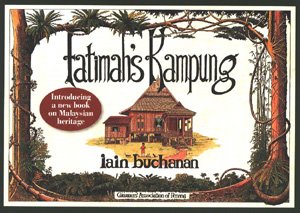
An illustrated book for children about Malaysian cultural and natural heritage loss as a result of economic development and modernity.
 Author and illustrator, Iain Buchanan, a former Scottish academic geographer, chose to shorten his academic career to dedicate his last 8 years to this first book. “I wanted to communicate effectively the sort of things I lectured about for twenty years: over-urbanization, the loss of community, deforestation, ecological collapse…Not through academic lectures and publications anymore but through a wider means of communication.” Read the rest of this entry »


 Responsible Tourism and Travel in Malaysia